
Bedtime Songs for Babies and Toddlers: A Calm Wind-Down Routine
How to build a short, calm bedtime routine with songs for babies and toddlers: choosing lullabies, sample routines by age and what to do when it stops working.
By The Cuddle & Sing team · · 6 min read
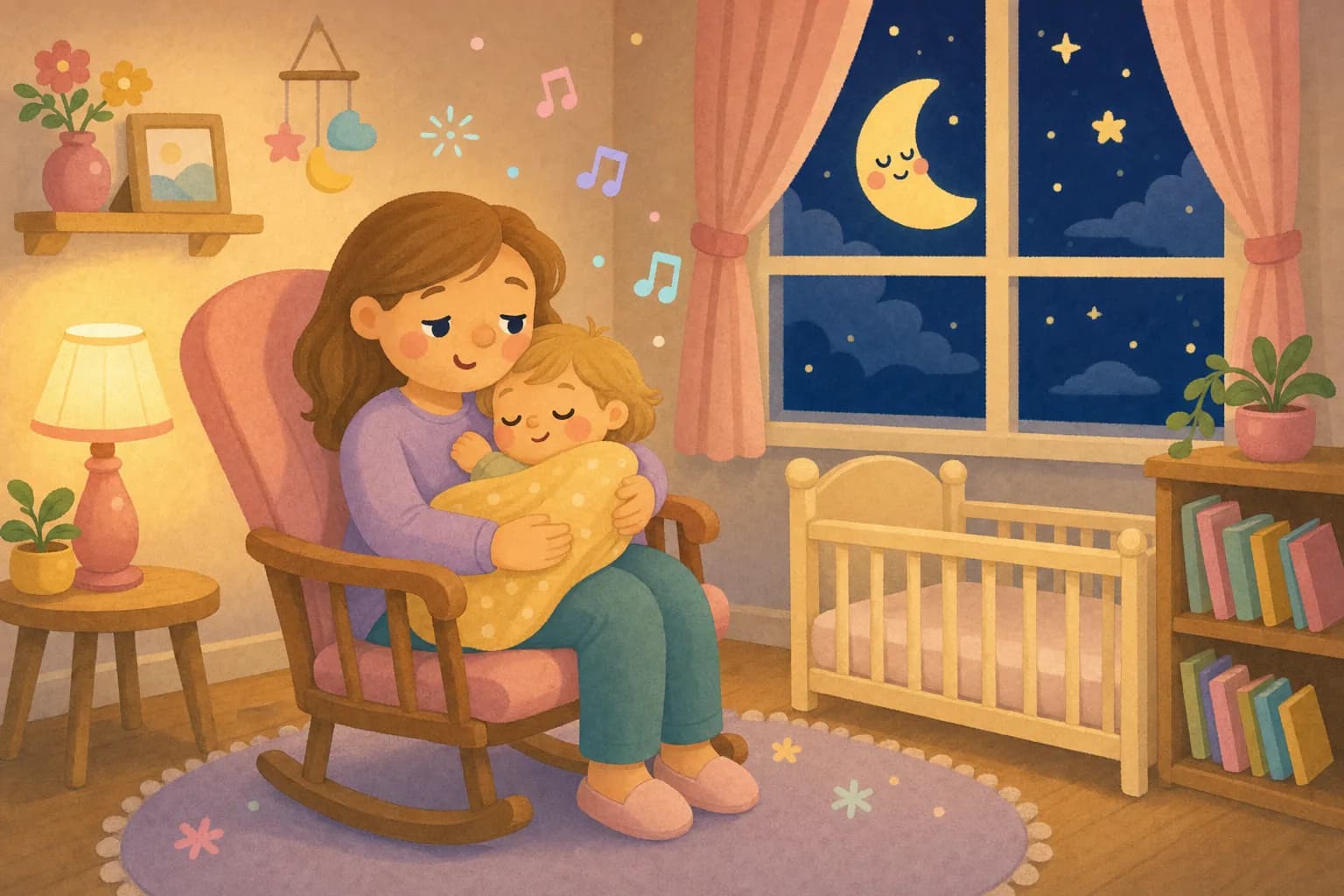
Bedtime songs can be one of the simplest, loveliest parts of a baby or toddler’s evening. Sung in the same order each night, a couple of familiar songs can gently signal that the day is winding down and sleep is coming. You don’t need a beautiful voice or a long playlist — just a few minutes, a dim room and the songs your child knows.
In this guide we share how to build a calm musical wind-down routine, how to choose bedtime songs, sample routines for babies and toddlers, and what to try when the routine that worked last month suddenly doesn’t. Every child is different, so treat this as a menu of ideas rather than a rulebook.
The short version
- A short, predictable wind-down with the same one or two songs can become a comforting bedtime signal.
- Slow, repetitive songs in your own voice tend to work best — perfect singing not required.
- Keep the routine simple enough that any carer can do it the same way.
- Songs are for the wind-down; for safe sleep itself, follow Red Nose guidance.
Why songs suit a bedtime routine
Little ones often find predictability comforting. When the same things happen in the same order each night — bath, pyjamas, book, song, lights off — they come to know what’s next. A song is a particularly lovely part of that sequence because it has a clear beginning and end, and because it’s you.
Many families also find singing helps the grown-up, too. Slowing your voice and your breathing for a lullaby can take the edge off a busy evening. That calm is often catching.
How to choose bedtime songs
There’s no perfect bedtime song, but the ones that tend to work share a few qualities:
- Slow. A gentle, rocking pace — slower than you’d sing during the day.
- Repetitive. Simple tunes and repeated lines are easy to predict and easy to remember.
- Soft. Sing more quietly than usual, and get quieter towards the end.
- Familiar. The same songs every night. Novelty can be lovely in the daytime, but at bedtime, familiar wins.
- Your voice. Your child knows and loves your voice. Recordings can be nice, but singing yourself means you can slow down, hum or stop whenever you need to.
Traditional lullabies to try
Twinkle Twinkle Little Star, Hush Little Baby and Rock-a-bye Baby are classics for good reason: they’re slow, simple and easy to remember. Any song you love can become a bedtime song if you slow it right down — a favourite pop song or a song from your own childhood or culture works beautifully.
Building your wind-down routine, step by step
- Choose a start signal. Dimming the lights or closing the curtains marks the shift from play to wind-down.
- Keep the order the same. For example: bath, nappy and pyjamas, a feed or drink if part of your routine, a book, then songs.
- Keep songs to a few minutes. Two or three songs is plenty. Long routines can be hard to keep up on tired nights.
- Lower everything. Voice, lights and energy all come down together. Save the action songs for the morning.
- End the same way each night. Your “last song”, a cuddle and a goodnight phrase you always use.
Aim for something you could manage on your most exhausted evening. A routine you can keep up most nights is far more useful than an elaborate one that only happens occasionally.
Sample bedtime routines by age
Babies (around 6–12 months)
Bath or wash, nappy and sleeping bag, feed if that’s part of your evening, then rock or sway gently while humming or singing one or two slow lullabies. Many babies like the same song sung softly a few times over. Keep your movements slow and the room dim.
Young toddlers (around 12–24 months)
Bath, pyjamas, teeth, a short book, then one or two songs in a cuddle. Toddlers often enjoy a small say in the routine — offering a choice between two bedtime songs can help them feel part of it without opening the door to “just one more”.
Older toddlers (around 2–3.5 years)
Bath, pyjamas, teeth, a book or two, then a song together. Some older toddlers like to sing part of it with you, or to “sing goodnight” to their toys or to the moon outside the window. A quiet, whispered final verse can be a fun signal that it’s nearly time to sleep.
Humming, handovers and different carers
Not everyone feels comfortable singing, and that’s fine. Humming the tune works well, as does speaking the words slowly and rhythmically. What matters most is the calm, familiar sound of a trusted voice.
If bedtime is shared between parents, grandparents or other carers, write down the routine and the song order so everyone does it the same way. A short note on the fridge — “bath, pyjamas, two books, Twinkle Twinkle, goodnight song” — can make handovers much smoother. It doesn’t need to be identical, just recognisable.
When the bedtime routine stops working
Routines that worked beautifully can suddenly wobble — after a holiday, an illness, a new sibling or just a busy stage of growing up. A few things to try:
- Go back to basics. Shorten the routine and keep it as consistent as you can for a week or two.
- Start a little earlier. An overtired toddler can find winding down harder.
- Add a choice. Letting a toddler choose between two songs can ease bedtime battles.
- Swap one song. If a song has become a negotiation, retire it gently and introduce a new one in the daytime first.
- Be kind to yourself. Some nights just don’t go to plan.
If you have ongoing worries about your child’s sleep, your Child and Family Health Nurse or GP is the best person to talk to.
A note on safe sleep
Songs belong to the wind-down, not the cot. Please follow Red Nose — Australia’s well-known safe-sleep organisation — for current guidance on safe sleeping environments, and keep toys, musical or otherwise, out of the sleep space where their guidance says to.
Bringing the songs from class home
Every Cuddle & Sing class ends with a calm goodbye, and many families tell us the quiet songs from class find their way into bedtime at home. If you’d like to hear live music together each week, take a look at Baby Beat for babies and Toddler Groove for toddlers, or find a class near you. For more musical ideas during the day, try our rainy-day music games.
Questions parents ask
What are good bedtime songs for babies?
Slow, simple, repetitive songs work well — traditional lullabies like Twinkle Twinkle Little Star, Hush Little Baby and Rock-a-bye Baby are popular. Any song you love can work if you sing it slowly and softly.
How long should a bedtime routine be?
Short enough that you can keep it up on tired nights. Many families find a routine of around 20 to 30 minutes, with just a few minutes of songs at the end, is manageable. What matters most is doing it in the same order.
Is it better to sing or play recorded lullabies?
Both can be lovely, but singing yourself lets you slow down, get quieter or stop whenever your child needs it — and your child knows your voice. Humming works too if you’d rather not sing.
What if my toddler keeps asking for one more song?
Offer a choice of two songs before you start, then always finish with the same “last song” and goodnight phrase. A clear, predictable ending makes it easier for toddlers to know when singing time is over.
Can musical toys go in the cot?
For safe sleep, follow Red Nose guidance on what should and shouldn’t be in the sleep space. We recommend keeping songs as part of the wind-down rather than relying on toys in the cot.
This article shares general ideas for families and isn’t medical or developmental advice. Every child is different — if you have questions about your child’s health or development, your GP or Child and Family Health Nurse is a great place to start.
Live music for little ones
Come and sing with us
Cuddle & Sing runs small, musician-led classes for babies and toddlers across Sydney’s North Shore and the Hills — with you right there in the music.